Agentic AI Workshop UAE: governed pilots for enterprise teams
Choose one important workflow and leave with a safe, testable agent pilot.
UAE teams design an agent around a real decision or workflow, then define approved knowledge, tool access, permissions, evaluation, security boundaries and human approval before planning a governed pilot.
- Recommended format
- Core workshop · 4–6 hours
- Delivery
- On-site / in person, online, or hybrid
01 · Best for
Is this the right workshop?
Business, product, operations, innovation and technical teams ready to examine one multi-step workflow together.
Not the best fit when
- — You need a finished software implementation rather than team training.
- — You want a passive keynote without practical work.
- — You require a legal or compliance guarantee.
02 · What changes after the workshop
What this program changes in practice
Agentic AI becomes useful when a team stops asking what an agent could do and starts defining one job properly. That means agreeing the trigger, the information the agent may use, the actions it may take, the decisions it must never make alone and the person who remains accountable. This workshop gives the team enough structure to have that conversation together before anyone invests in a platform, integration or ambitious automation project.
The session is not a fixed sequence of demonstrations. The facilitator works with the team on Choose the workflow, Define the agent’s job, Connect sources and tools, using Agent Design Canvas, ChatGPT, Your approved AI tools when those systems are approved and available. Participants compare first results, make missing context visible and improve the work together. They learn not only which request works, but why an output is reliable enough to move into the next working step.
The value should not end when people leave the room. Exercises therefore produce concrete outputs such as Agent Design Canvas, Permission and approval map, Failure-test checklist. They give colleagues a traceable starting point, show where human review is still required and make the next pilot smaller and more realistic. Optional follow-up work can build on those artefacts instead of beginning again with another general introduction.
- Select an agent opportunity worth testing
- Separate agent work from human decisions
- Design permissions and review points
- Plan a small pilot with clear tests
03 · Tools your team will use
Tools your team will use
- Agent Design Canvas
- Define the job, sources, tools, permissions, decisions and human checkpoints before building an agent.
- ChatGPT
- Draft, analyse, research and turn recurring work into reusable team instructions.
- Your approved AI tools
- Exercises adapt to the systems, licences and data boundaries your organisation has approved.
04 · From uncertainty to a shared way of working
Choose one important workflow and leave with a safe, testable agent pilot.
- Before
- The team has agent ideas, but the useful boundary, evidence, permissions and owner are still unclear.
- In the room
- The team uses Agent Design Canvas, ChatGPT, Your approved AI tools on its own examples. Every exercise ends with checking, improvement and a clear human decision.
- The day after
- Participants leave with more than notes: Agent Design Canvas, Permission and approval map, Failure-test checklist and an agreed next step.
05 · A practical syllabus
A practical syllabus
01 Choose the workflow
Map the current work, friction and decision owner.
02 Define the agent’s job
Set the goal, boundaries, inputs and expected output.
03 Connect sources and tools
Decide what the agent may read, use and change.
04 Design human control
Add approvals, escalation and a visible source trail.
05 Test before pilot
Create failure cases, success measures and a first pilot plan.
06 · What your team takes away
A prepared workshop, not a generic presentation
- Agent Design Canvas
- Permission and approval map
- Failure-test checklist
- Pilot brief with owner and next step
Preparation and resources
- • Sponsor alignment call
- • Short participant questionnaire
- • Examples adapted to your work
- • Facilitated live practice
- • Digital resources
- • Concise facilitator summary
Optional follow-up: Optional follow-up clinics and adoption support can be added after the workshop.
Plan a workshop around work worth improving
What determines the quote?
Share your team size, preferred format, location, approved tools and one workflow you want to improve. These details help scope the preparation, facilitation and any follow-up. Ask for an itemised proposal so you can compare the same scope—not just a day rate.
How should we assess the value?
Choose one representative task and record a baseline before the workshop. Compare the time needed, corrections required and quality of the reviewed output afterwards. Agree who owns the next trial. Treat productivity gains as something to measure, not a promised percentage.
07 · Delivery options
One workshop, three ways to take part
The learning goals, practical exercises and take-away resources stay consistent. We adapt the room, collaboration tools and facilitation rhythm to the way your team is joining.
- On-site / in person
- Delivered at your organisation or an agreed venue, with the facilitator and participants working together in the room.
- Online
- A fully live, facilitated workshop using an agreed video platform, shared exercises and structured small-group work.
- Hybrid
- Designed for a team split between the room and remote participants, with activities adapted so both groups can contribute and receive support.
Workshop evidence · Lausanne
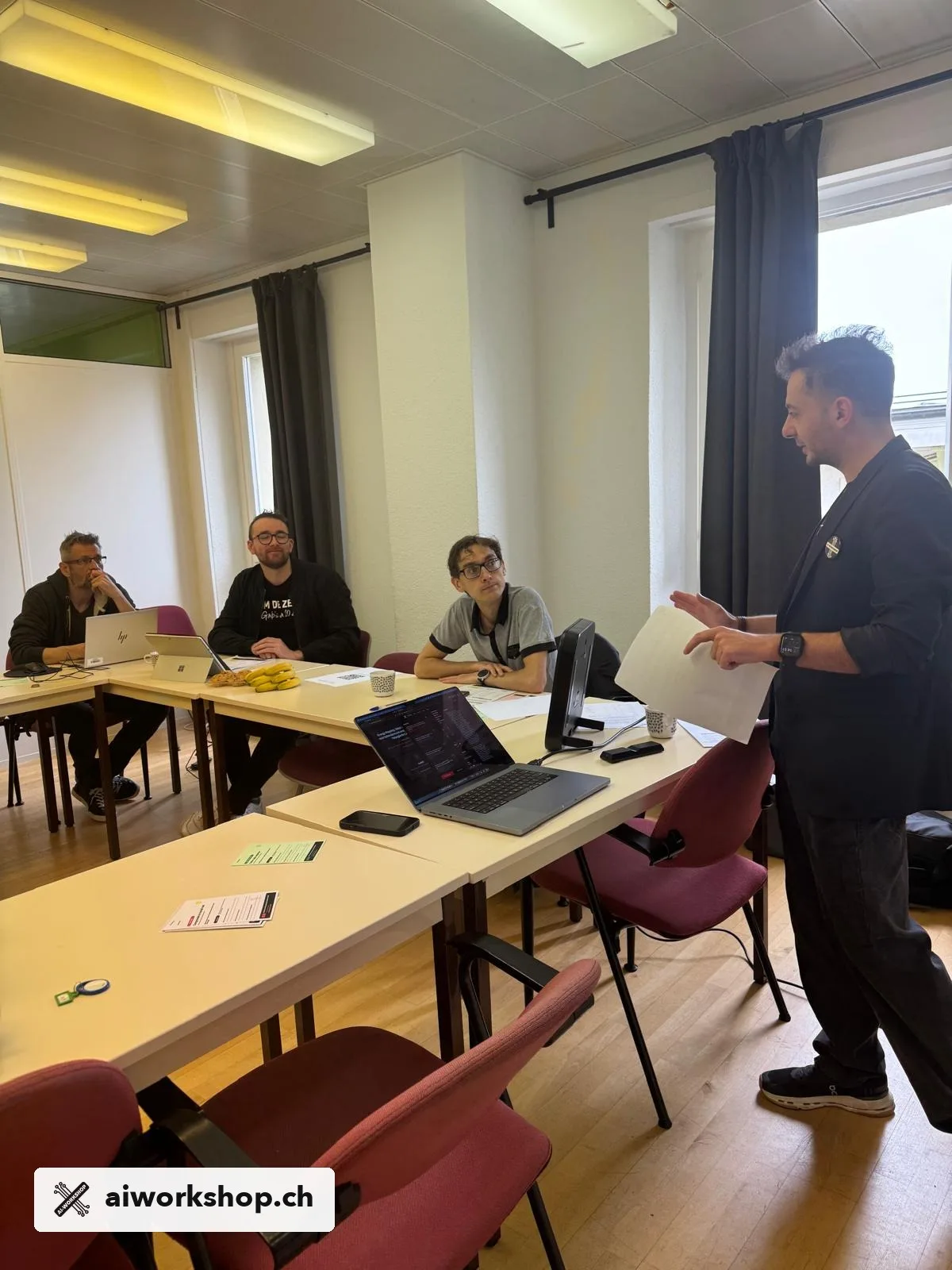
A proven canvas, tested in a real Lausanne workshop
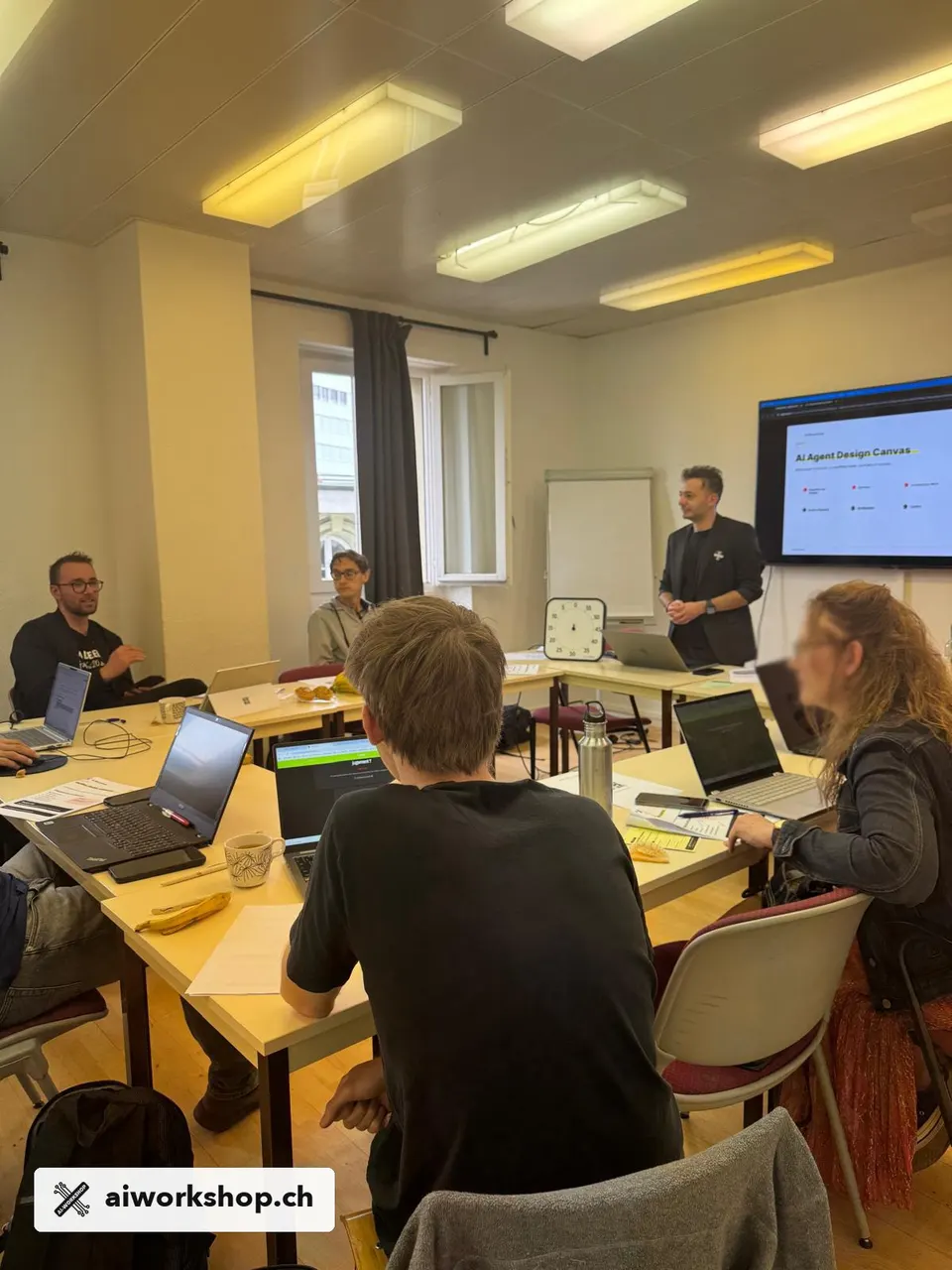
The Agent Design Canvas and public workshop repository show how participants move from a broad idea to a bounded agent brief with sources, permissions, review and test cases.
 View public workshop evidence
 Published evidence · Switzerland
A documented workshop, with inspectable outputs.
At UNIL in Lausanne, a 90-minute Agentic AI and finance workshop produced 18 structured agent specifications. The case study documents the audience, method, materials and public output portfolio.
This is Swiss workshop evidence. It is not a local client reference for France, Austria, the UAE or Saudi Arabia, and it does not claim deployment or financial outcomes.

08 · Facilitated by a practitioner
Facilitated by a practitioner
George Raymond Alchoufi combines software engineering, facilitation and executive coaching. The session is adapted to your team’s work, approved tools and review responsibilities.
Program content reviewed July 2026
Delivered across Switzerland
Available on-site in Zürich, Geneva, Lausanne, Basel, Bern and other Swiss locations by arrangement, with hybrid delivery for distributed teams.
Continue your team’s learning
Questions before booking
What will our team achieve in the Agentic AI workshop?
Choose one important workflow and leave with a safe, testable agent pilot. The practical outcomes are: Select an agent opportunity worth testing; Separate agent work from human decisions; Design permissions and review points; Plan a small pilot with clear tests.
Who is the Agentic AI workshop designed for?
Business, product, operations, innovation and technical teams ready to examine one multi-step workflow together.
Which tools will participants use?
The practical stack includes Agent Design Canvas, ChatGPT, Your approved AI tools. Exercises are adapted to the licences and systems your organisation has approved.
How long is the workshop and how is it delivered?
The recommended format is Core workshop · 4–6 hours. Every core workshop is designed to stay within four to six hours; alternatives include Focused workshop · 4 hours. Choose an in-person session at your organisation or an agreed venue, a fully online workshop, or a hybrid format.
What preparation is required?
No technical prerequisite is required. We hold a short sponsor alignment call and participant questionnaire, then adapt examples to approved tools and non-sensitive work.
What does the team take away?
The working package includes Agent Design Canvas, Permission and approval map, Failure-test checklist, Pilot brief with owner and next step, digital resources and a concise facilitator summary.
Share this workshop
Use the concise Markdown version for citations or download the PDF brochure for internal review.